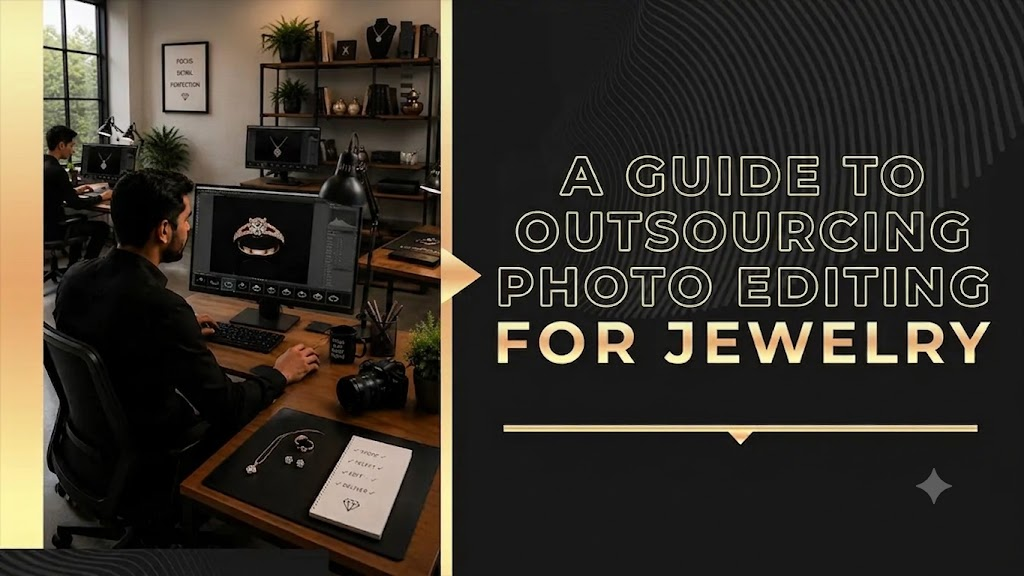
The holiday launch is exactly four days away. Your photographer delivered three hundred raw shots of your new pavé diamond rings and high-polish gold bands.
They look realistic, sure, but the metal surfaces show tiny dust specks. The diamonds look slightly dead under the studio lights.
Your in-house designer is buried in website layouts and social media assets. They try to fix a few images, but zooming in on macro details takes forever.
Hours bleed into days. You miss the launch window, and your competitors are already running ads with sparkling, pristine product imagery.
This scenario plays out constantly in luxury eCommerce rooms. Beautiful luxury product photography can easily fall apart during the image post-production phase if you do not have the right hands on deck.
Finding a reliable partner for outsourcing photo editing for jewelry can mean the difference between scaling your revenue and burning out your internal team. Let us unpack how to do it right.
Outsourcing Photo Editing for Jewelry: What Smart Buyers Evaluate First
When you begin looking at third-party editors, do not just look at their prettiest portfolio pieces. Anyone can spend four hours perfecting a single hero image for a website banner.
Instead, you need to evaluate their ability to maintain visual consistency across an entire catalog. Your website grid will look messy if one ring has a warm gold tone and the next looks greenish-yellow.
Raw Capture ➔ Initial Color Match ➔ Detail Polish ➔ QC Alignment
Color correction is not just about making things look bright; it is about absolute accuracy. If a customer orders a rose gold necklace and opens a box to find something resembling copper, that item is coming right back.
Your return rates will skyrocket simply because your digital assets lied. Smart buyers look for teams that ask for your specific brand standards guide right from the start.
You must also consider workflow compatibility. How do they handle file transfers?
If you have to manually upload hundreds of gigabytes to a clumsy, slow server every Tuesday night, the partnership is already broken. Look for partners who fit into your existing cloud architecture without friction.
Why Jewelry Editing Is a Different Animal Altogether
Let’s face it: editing a leather handbag or a pair of sneakers is relatively straightforward. Jewelry is a completely different beast because you are dealing with highly reflective, tiny, intricate objects.
A single gemstone enhancement requires a deep understanding of how light interacts with facets. If an editor applies a generic smoothing filter to a diamond, they will wipe out the natural fire and brilliance, making a four-carat stone look like cheap plastic.
Reflection control is where most generalist retouching vendors completely fail. High-polish gold and platinum act like tiny, curved mirrors.
They capture the camera lens, the photographer’s reflection, and the studio softboxes. A specialized jewelry editor knows how to clean up these distracting reflections while keeping the metal looking metallic, not painted.
“Many general photo editing services treat jewelry like any other hard product. They over-smooth the edges and obliterate the natural grain of the metal, destroying the luxury feel that justifies a premium price tag.”
— Thomas Kane, Senior Visual Director, EGJewel
If your vendor lacks this specific expertise, your ecommerce jewelry photography will lose its premium edge. Every prong, every clasp, and every micro-pavé stone requires surgical precision during background cleanup and final polishing.
The Hidden Costs Nobody Mentions During Vendor Selection
The lowest price per image often turns out to be the most expensive mistake you can make. Cheap rates usually hide a mountain of hidden operational costs that drain your time and sanity.
| Factor | Low-Cost Vendor | Specialized Jewelry Team |
| Revision Cycles | Multiple rounds; requires constant micromanagement | Minimal; usually right on the first or second try |
| Communication | Delayed responses due to extreme time zone gaps | Dedicated account management with overlapping hours |
| Onboarding Time | Weeks of trial and error at your expense | Structured onboarding with clear style documentation |
| Launch Deadlines | High risk of missed dates due to erratic output | Predictable, guaranteed turnaround times |
Think about the time your team spends writing out revision notes. If you have to circle thirty dust spots on every single ring image a vendor sends back, you are basically doing the work for them.
Time is money in eCommerce. Every day your jewelry catalog images sit in a broken feedback loop is a day those products are not generating revenue on your site.
Questions That Reveal More Than a Sales Pitch Ever Will
When you are interviewing potential image post-production partners, move past the standard questions about capacity. You need to peek behind the curtain of their actual quality control systems.
Ask them exactly how they train their retouchers specifically for diamond photo editing. Do they have a dedicated quality assurance manager who inspects every asset before it reaches your inbox?
Editor Output ➔ QA Specialist Inspection ➔ Brand Stylist Review ➔ Client Delivery
“Send us a sample” is standard advice, but you should take it a step further. Do not send them your easiest, most perfectly lit shot.
Send them a challenging image with tricky reflections and complex stone settings. This tests their true limits.
“The true test of a vendor is not their first sample, but their fiftieth image in the middle of a high-volume rush. Consistency under pressure is what builds multi-year partnerships.”
Make sure to ask about their communication setup during peak seasons. If a critical web banner image needs an emergency adjustment on a Friday afternoon, who can you call?
Red Flags That Should Make You Pause
Be careful if a provider promises the world for pennies. If the pricing sounds too low to support fair wages for skilled digital artisans, your quality will eventually drop.
Another warning sign is a complete lack of technical documentation. A great partner will want to document your preferences for shadow depth, clipping paths, and reflection opacity.
If they do not ask for a style guide or offer to build one with you, they are likely guessing what you want. That guessing game gets exhausting very quickly.
Watch out for vague turnaround promises like “as soon as possible.” You cannot build a marketing calendar around assumptions; you need firm commitments.
What Great Jewelry Editing Partnerships Actually Look Like
A stellar partnership feels like an extension of your own studio team. Over time, the editors learn your brand’s unique visual language.
They know exactly how much texture you like to keep on your matte gold pieces. They understand how bright your white gold should look against a pure white background.
Feedback loops become shorter and less frequent. You drop files into a folder, and they return exactly as expected, letting you focus entirely on marketing and product development.
This level of alignment gives you the freedom to scale your product image retouching needs during massive product launches without hiring seasonal staff.
Pricing Models Explained Without the Confusion
Most jewelry photo retouching providers offer a few different ways to pay, and each fits a different style of business.
Per-image pricing is great for brands with predictable, steady drops. You know exactly what each asset costs, making it simple to calculate your margins.
Monthly volume pricing works best for high-volume ecommerce stores that shoot hundreds of new pieces every single month. This model often gets you the best rates and guarantees dedicated studio space.
Project-based pricing is ideal for large seasonal catalog overhauls or rebranding projects where you need to update thousands of legacy assets all at once.
The One Investment That Often Pays for Itself
Investing in professional jewelry retouching is rarely just an administrative expense; it directly impacts your digital conversion rates.
When jewelry looks immaculate online, customers feel secure buying high-ticket items through a screen. High-quality imagery builds trust, reduces purchase hesitation, and lowers your return rates.
Before You Sign Anything, Use This Quick Buyer Checklist
Before you send over your first massive batch of raw files, run through this quick checklist to ensure your partnership starts on solid ground:
- Confirm file formats: Ensure they accept your camera’s raw formats and can deliver layered PSDs if your design team needs them.
- Establish a clear naming convention: Your product SKUs should match the final edited image filenames perfectly to prevent upload chaos.
- Set up a secure backup system: Never let a vendor hold the only copy of your master files; always keep your own secure archive.
- Define the escalation path: Know exactly who to contact if an urgent batch fails to meet your quality expectations.
- Run a small paid pilot project: Test their communication, speed, and accuracy with a small batch of ten images before signing a long-term agreement.
Frequently Asked Questions
1. How do jewelry editing vendors handle non-disclosure agreements to protect unreleased designs?
Reputable agencies sign comprehensive non-disclosure agreements before you send any imagery. They use secure, password-protected servers and restrict internal team access to your files to prevent leaks of your upcoming collections.
2. What happens to image ownership and copyright when outsourcing photo editing for jewelry?
You should always maintain full ownership and copyright of both your raw and final edited assets. Ensure your contract explicitly states that all work created by the vendor is considered “work made for hire” and belongs entirely to your brand.
3. How do specialized editing teams handle sudden seasonal volume spikes before the holidays?
Top-tier vendors maintain a flexible bench of trained editors who can be spun up during peak periods. They rely on your shared style guides to onboard internal backup talent quickly without sacrificing your brand’s visual consistency.
4. Can jewelry photo editors fix poor lighting and focus issues from the original shoot?
Editors can fix minor lighting imbalances and combine multiple exposures through focus stacking. However, digital editing cannot completely save a blurry, poorly lit shot without making the final product look artificial and low-quality.
5. How do modern editing workflows handle color matching for unique, multi-tonal gemstones like opals or alexandrite?
Specialized jewelry editors typically request physical color references or high-resolution video clips of the stone under natural light. They use advanced manual masking and selective color grading layers to capture the unique play-of-color that automated filters miss entirely.
Conclusion: Making the Shift with Confidence
Handing over control of your brand visuals can feel uncomfortable at first. Your imagery is the face of your business, and it makes sense to protect it fiercely.
However, keeping everything in-house often caps your growth potential. By outsourcing photo editing for jewelry to a specialized team, you free up your creative energy to build better collections and connect with your audience.
The goal is to stop spending your late nights fixing metal reflections and start spending them growing your business. Find a partner who values your details as much as you do, and let them do what they do best.